Plasma or Laser Cutting: Which Fits?.
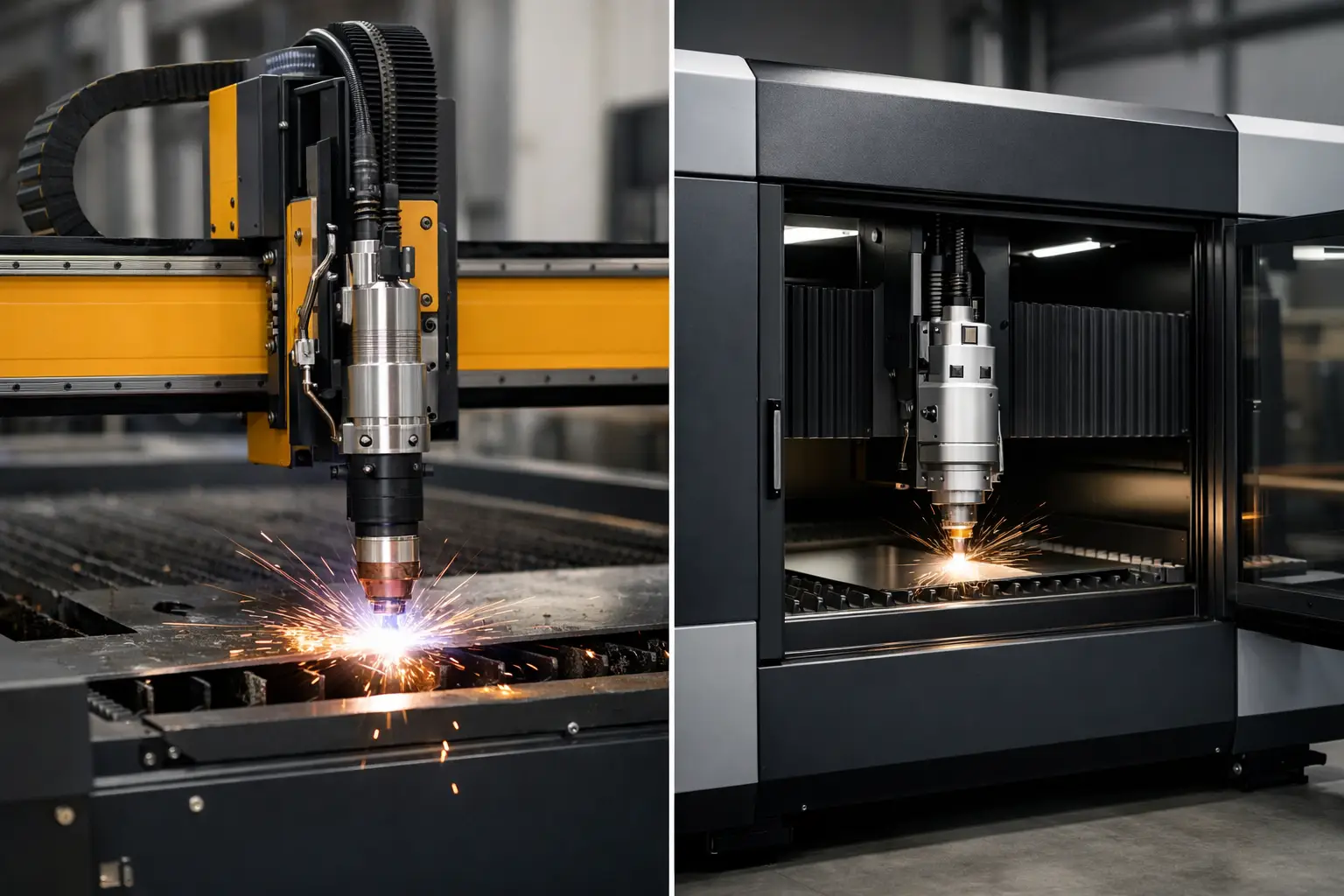
A lot of buying mistakes start with the wrong question. Instead of asking whether plasma or laser cutting is better, the real question is “Which process is right for my business?”
For Australian fabrication and manufacturing businesses, that distinction matters. A machine that looks impressive on paper can become a poor fit once you factor in plate thickness, edge quality requirements, operator skill, floor space, service access and the cost of downtime. Choosing between plasma or laser cutting is less about chasing the newest technology and more about matching the process to your workload.
Plasma or laser cutting – start with the work, not the brochure
The cleanest way to compare these two processes is to look at what each one is built to do.
Plasma cutting uses an electrically conductive gas to create a high-temperature arc that melts metal and blows the molten material out of the cut. It is a proven process for conductive metals and has long been a strong option for fabrication shops that need reliable throughput on mild steel, stainless and aluminium.
Laser cutting, particularly fibre laser technology, uses a concentrated beam of light to cut material with very high precision. It is usually chosen where cut quality, fine detail, repeatability and speed on thinner materials are high priorities.
That sounds simple enough, but the trade-off sits in the detail. Plasma is often the practical workhorse for heavier plate and general fabrication. Laser is often the stronger choice for fine-feature work, cleaner edges and higher precision production. If your job mix includes both, the answer may not be either-or forever. It may be which process should come first.
Where plasma cutting makes the most sense
If your workshop processes structural components, brackets, base plates, gussets or heavier steel parts, plasma often earns its place quickly. It is especially effective when you need solid cutting performance across a broad range of conductive materials and thicknesses without stepping into the higher capital cost that usually comes with laser systems.
Modern CNC plasma systems are not the rough-and-ready machines some buyers still picture. With the right machine build, motion control, height control and programming, plasma can deliver strong cut quality and dependable output for serious production work. For many fabrication businesses, it hits the sweet spot between speed, capability and operating cost.
Plasma also tends to be more forgiving in environments where material condition is not always perfect. If you are regularly processing plate with mill scale, surface variation or the kind of real-world inconsistencies common in busy workshops, plasma can be a very practical choice.
That said, honesty matters here. Plasma does produce a wider kerf than laser, and edge finish is generally not as clean on thinner material or highly detailed profiles. If your parts need minimal post-processing and very sharp feature definition, those limitations can start to matter.
Where laser cutting pulls ahead
Laser cutting becomes very compelling when precision is a production requirement, not just a preference. If your work involves thin sheet, intricate profiles, tight tolerances or parts that go straight to folding, welding or assembly, a fibre laser can significantly improve efficiency downstream.
The biggest advantage is not simply that the cut looks cleaner. It is that cleaner, more accurate parts can reduce handling, grinding, fitting time and rework. Those hidden labour costs often decide whether laser stacks up commercially.
Laser systems also offer excellent speed on thinner materials. In the right application, that translates into faster throughput and more consistent part quality across repeated jobs. For businesses servicing industries where presentation, fit-up and repeatability are non-negotiable, laser can be the stronger long-term investment.
But laser is not automatically the better financial decision for every operation. If most of your work is heavier plate, straightforward geometry and fabrication where absolute edge refinement is not critical, paying for laser capability you rarely use may not improve profitability.
Thickness, tolerance and edge finish
This is where many buying decisions should really be made.
If your work is mostly thin to medium sheet and the finish of the cut edge affects the next stage of production, laser usually has the edge. Holes are cleaner, detail is sharper and parts often need less secondary work. That benefit compounds over time in workshops where labour is expensive and schedules are tight.
If your work moves into heavier plate and the priority is productive cutting rather than cosmetic finish, plasma can be the smarter choice. It handles heavier material well and gives many fabrication businesses the output they need without overcapitalising.
Tolerance expectations matter too. Not every workshop needs laser-level precision. Some do. Some only need it on a handful of jobs each month. That is why an honest assessment of your typical work is more useful than focusing on the best possible cut a machine can produce under ideal conditions.
Running costs are not just about consumables
Too many comparisons stop at purchase price and consumable cost. In reality, the full cost of ownership includes programming time, operator training, extraction requirements, maintenance, service response and the revenue impact when a machine is down.
Plasma systems can offer very attractive economics, particularly for businesses that need capability and throughput without the higher upfront cost of a laser. Consumables and wear items still need to be managed properly, but for many operations the numbers work well.
Laser systems can deliver strong production value, especially where high-speed thin sheet cutting and reduced secondary finishing save labour. However, buyers should assess the total package, not just the machine headline. Installation, support, service access and operator capability all affect return on investment.
This is where local technical support becomes more than a selling point. If a machine stops and you are waiting days for answers, the cheapest option on quote day can become the most expensive machine on your floor.
Software, automation and the real production picture
Cutting performance is only part of the story. The right software, nesting strategy and machine configuration often make the difference between a machine that looks good in a demo and one that consistently delivers in production.
For plasma, good height control, stable motion and smart programming are essential if you want reliable quality and consumable life. For laser, material handling, nesting efficiency and process control play a major role in actual throughput.
That means your decision on plasma or laser cutting should include how parts enter and leave the machine, who programs it, what your operators can realistically manage, and whether the machine can be configured to suit your workflow. A technically sound machine with poor implementation is still a poor result.
How to decide what fits your business
The most practical buyers usually look at five things: the material types they cut most, the common thickness range, the finish their customers expect, the labour involved after cutting, and how costly downtime is to the business.
If your workshop mostly cuts heavier conductive metals for fabrication, plasma may be the right answer. If you need cleaner edges, finer detail and more precision on thinner materials, laser may justify the investment. If your workload is mixed, the right answer depends on which jobs drive your margin and where your production bottlenecks sit today.
This is also the point where straight advice matters. A supplier should be able to tell you when plasma is enough, when laser is warranted, and when your expectations do not align with the process. If every conversation leads to the most expensive machine, you are not getting advice. You are getting a sales pitch.
For that reason, many Australian businesses prefer to deal with a company that actually designs, builds, programs and supports the systems it supplies. ART CNC works with customers this way because machine selection is rarely just about the machine. Because ART CNC offer both CNC plasma AND CNC laser, they will give you unbiased advice on what is best for your business, not give you the hard sell on what they want to sell. It is about making sure the process, software, configuration and support model all fit your operation.
The best choice is the one that keeps production moving
There is no trophy for buying the most advanced process if it does not suit your work. There is also no benefit in underspecifying a machine and paying for that decision every day in rework, delays and lost capacity.
A good plasma system can be exactly what one fabrication shop needs. A fibre laser can be the right move for another. The difference comes down to your materials, your tolerances, your workflow and how much value you place on cut quality versus cutting cost.
If you are weighing up plasma or laser cutting, start with the jobs you quote every week, not the occasional one that looks impressive. The right machine should earn its keep on your normal work, support your operators and keep production moving when the workshop is under pressure.